
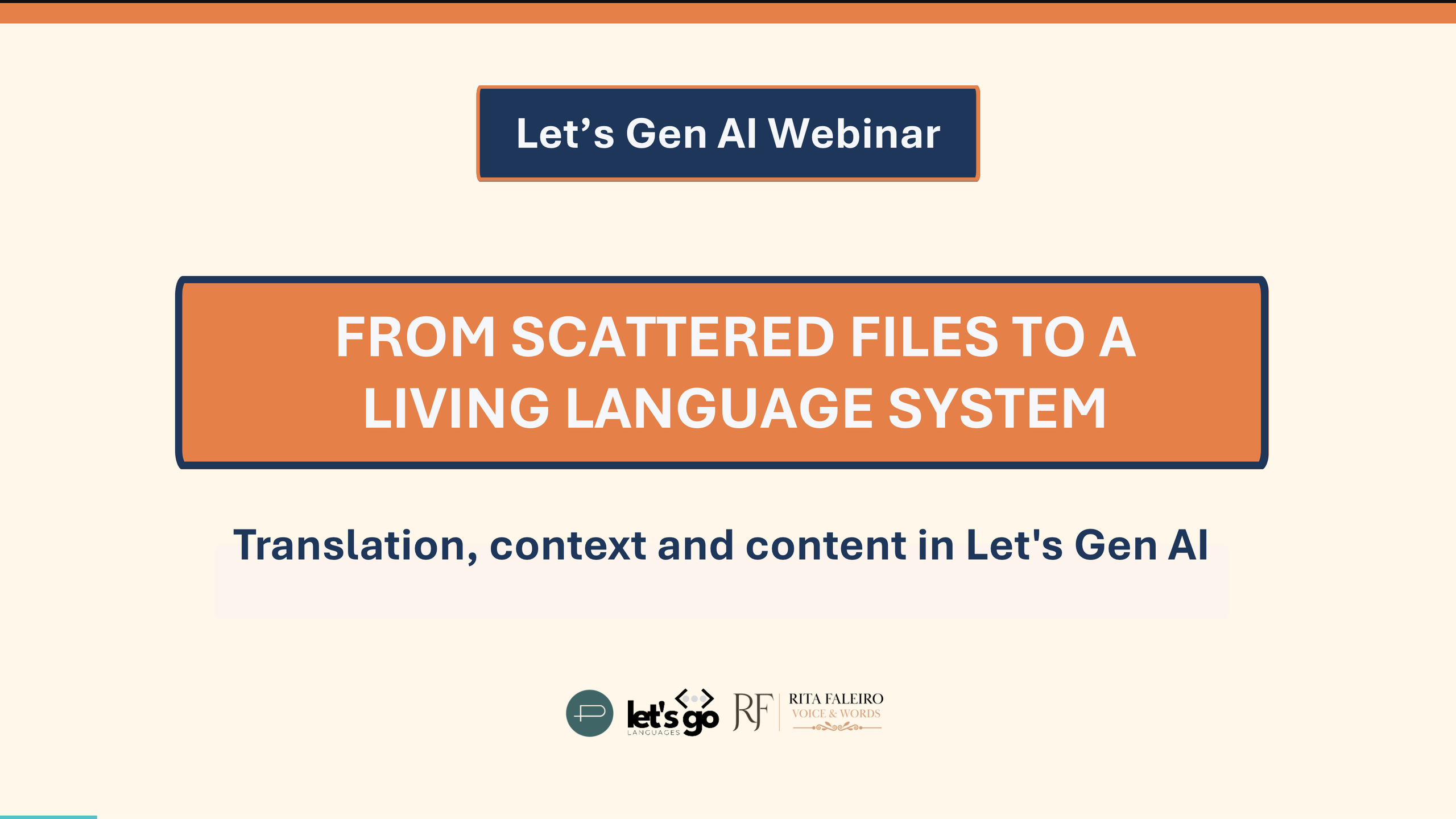
What if one of the biggest challenges in professional translation has nothing to do with translating?
Think about your last project.
How many applications did you open? How many documents did you consult? How many times did you interrupt your work to retrieve a piece of information you knew you already had somewhere?
A terminology decision. A client’s preference. A previous translation. A reference document you were certain you’d saved.
Sound familiar?
As a freelance translator and localization specialist, I’ve become increasingly interested in a question that doesn’t always receive enough attention in discussions about artificial intelligence:
What if AI’s most interesting contribution to our profession isn’t generating translations, but changing how we manage the knowledge behind them?
Translation Technology, AI and the Problem of Fragmented Workflows
We talk extensively about machine translation, AI-assisted translation, productivity and automation.
And those conversations matter.
But professional linguistic work involves much more than producing target-language text.
We accumulate knowledge, make decisions, establish terminology, and learn how individual clients communicate.
And then?… We spend an extraordinary amount of time trying to find that knowledge again.
The problem becomes even more interesting when our work extends beyond translation into localization, linguistic quality assurance and multilingual content creation.
Can technology help us connect these different dimensions of our work?
And if it can, what happens to our role as language professionals?
A Different Kind of ProZ Webinar
On 21 October 2026, I’ll be presenting:
From Fragmented Workflow to Connected Workspace: Translation, Context and Content in Let’s Gen AI
Rather than offering a conventional feature-by-feature software presentation, I’ll approach the platform through the eyes of a working linguist.
There will be a practical scenario, real workflow questions and a few things worth thinking critically about.
And yes, not everything will go exactly as expected.
But I won’t spoil the surprises here.
Why This Question Matters to Me
I’m also neurodivergent and have ADHD.
For me, fragmented information, constant context switching and the need to navigate multiple tools are not abstract productivity concepts. They are part of the practical challenges of managing my professional work.
This makes the idea of a more connected workspace particularly interesting.
Not as a magical solution. Not as a substitute for expertise.
But as a possibility worth investigating.
Can we reduce the friction around linguistic work without reducing the professional judgement that gives it value?
That’s the question I’d like to explore with you.
Join Me on 21 October
If you’re a translator, localizer or language professional curious about the relationship between AI, translation technology and professional workflows, I’d love you to join me.
Webinar: From Fragmented Workflow to Connected Workspace: Translation, Context and Content in Let’s Gen AI
Date: 21 October 2026
Platform: ProZ.com
Let’s explore what happens when we stop looking at translation tools in isolation and start asking how our linguistic knowledge travels with our work.
Less friction. More context. The same professional responsibility.
And perhaps a surprise or two along the way.




Oh yes, that’s something that has happened quite a lot to me – having to spend precious time searching for some specific target term which I had employed for that client somewhere in some document (which I wasn’t even sure when that happened, not to mention not remembering the name of the file). So I think that’s a really interesting topic and if AI can help with this, then that’s even better. I’ll be looking forward to the webinar.
Thank you Elias! I’m looking forward to hearing your feedback on the webinar!