
There is nothing particularly Instagrammable about this photograph.
There are books being used to create the right working height, a box from a drawing tablet supporting part of the setup, pieces of paper within reach, more than one computer, visible cables, an audio adapter, a large orange mug and a cable repaired with black electrical tape.
This is not a carefully designed office prepared for a photograph. It is a real home office, adapted gradually around the work that actually happens here.
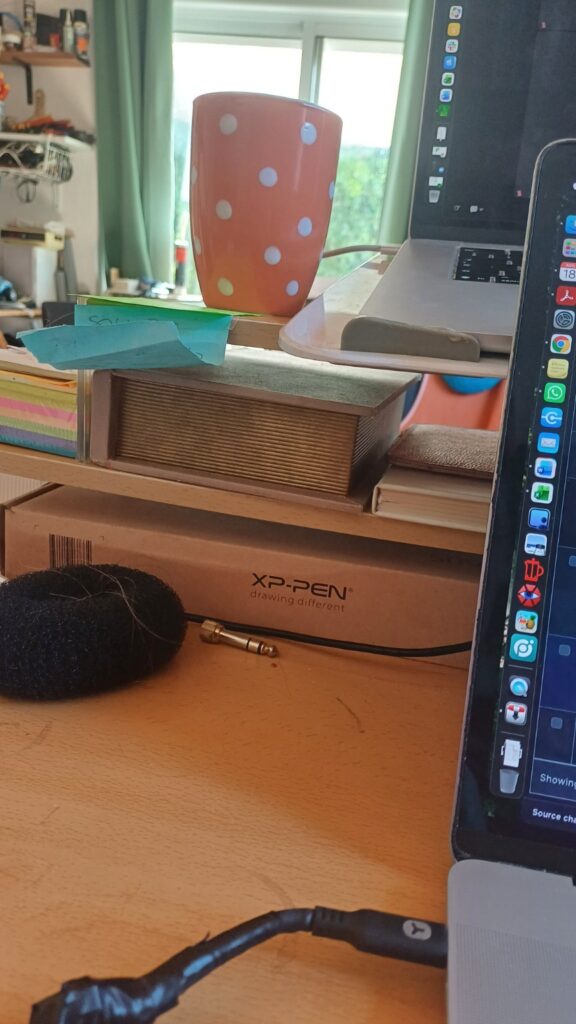
And a great deal of work happens here.
This photograph captures one small home office shared by two people who, between them, work in four different professional roles.
Two translators. One piano teacher. One electronics repairer.
Four professions operating from a single room, each with its own equipment, tools, working methods and practical requirements.
This is not a kitchen, nor is it a temporary corner where someone occasionally opens a laptop. It is a real multifunctional home office that has been continuously adapted to support several forms of professional work within a very limited space.
What a Remote Translator’s Workspace Really Looks Like
Images of remote work often show immaculate desks, perfectly aligned equipment, expensive chairs and decorative objects chosen according to a coordinated color palette. Those spaces exist, of course, but they are not the only places where serious professional work is done.
My workspace was not created to look impressive. It was created to help me work.
From here, I translate and localize content, revise texts, perform machine translation post-editing, evaluate linguistic output and work with different digital tools and file formats. Some projects require several windows to remain open at the same time. Others involve terminology databases, translation memories, reference documents, communication platforms and quality assurance tools running simultaneously.
One screen is often not enough. One device is not always enough. And the apparently random objects surrounding the computers are not necessarily random at all.
They are part of a system that has been adjusted repeatedly until it became functional.
Translation alone requires more equipment and space than people often imagine. In this room, there are two translators, which means that two separate professional workflows must coexist. But translation is only one part of what happens here.
Four Professional Roles in One Small Room
The same small home office must also accommodate the work of a piano teacher. That requires access to sheet music, teaching resources, audio equipment and the practical tools needed to prepare lessons and support students.
Then there is electronics repair and modification, which brings an entirely different set of requirements: devices, components, cables, adapters, tools, testing equipment and enough working surface to handle delicate technical tasks.
These professions have very little in common when it comes to physical organization, yet they all need to function inside the same room.
A translation project may be open on one computer while electronic equipment occupies another part of the space. Musical materials may need to be accessed between deadlines. One person’s working arrangement must leave enough room for the other person to continue working.
This requires constant negotiation, adaptation and a very practical understanding of what each person actually needs.
A Multifunctional Home Office Built Around Real Needs
The result is not minimalist because minimalism is not the objective.
Functionality is.
The books supporting the equipment create the height required for a workable setup. The boxes provide storage or an additional surface. The cables connect devices used for different kinds of work. The handwritten notes keep essential information visible and immediately accessible.
The computers are not props placed there to make the room look professional. They are used every day for real professional projects.
Every available centimeter has to work.
When a single space serves several purposes, objects cannot always be hidden away after each task. Some equipment needs to remain connected. Frequently used tools must stay within reach. Materials belonging to entirely different professions inevitably exist side by side.
This is what adaptation looks like in practice: identifying a problem, finding a workable solution and continuing.
Professionalism Does Not Require a Perfect Office
Online images of home offices tend to show large, immaculate desks, coordinated accessories, carefully positioned plants and almost no evidence that anyone genuinely works there.
That is not the reality of every remote professional.
Sometimes professionalism looks like creating four viable working environments inside one small room. Sometimes it means reusing a solid box as part of the setup, raising a device with books, repairing a cable instead of immediately replacing it and accepting that different tools must occupy the same surface.
The room does not need to look empty to support serious work.
Professional quality comes from the work itself: accurate research, careful preparation, technical knowledge, reliable tools, responsible decision-making and the ability to deliver consistently.
The furniture does not translate a document accurately. Matching accessories do not prepare a piano lesson. An immaculate desk does not diagnose a fault in an electronic device.
People do those things.
What the Photograph Does Not Show
The photograph captures only one small section of the room, but even that limited view contains traces of the different kinds of work performed here.
What it cannot show is the concentration required to move between professions, deadlines and tools. It does not show the hours spent researching terminology, revising a translation, preparing teaching materials or identifying the cause of an electronic fault.
It cannot show the invisible logistics behind sharing a small professional space: coordinating schedules, managing noise, moving equipment, protecting materials, keeping essential tools accessible and changing the room’s function according to the work being done at that particular moment.
A multifunctional home office is not simply a room containing many objects. It is an environment that must repeatedly transform without ever fully ceasing to be any of the things it supports.
It is a translation office.
It is a music teaching and preparation space.
It is an electronics workbench.
And it is shared by two people who need to make all four professional roles fit inside it.
A Four-in-One Office That Works
Would more space make some things easier? Of course.
But waiting for ideal conditions is not always a realistic option. Work still needs to be completed. Clients still need their projects delivered. Students still need their lessons. Electronic devices still need to be examined and repaired.
So we have made the available space work.
Not perfectly. Not decoratively. Practically.
This photograph is not an image of disorder. It is an image of spatial problem-solving. It shows how two people have adapted one small room to create a functioning professional environment for four different roles.
There is no empty surface prepared for social media. There is no carefully manufactured appearance of productivity. There is simply the infrastructure required for the work that happens here every day.
Two people. Four professions. One very small office.
And somehow, it all fits.





0 Comments