
I seem to have accidentally built an ISO 9001:🐢 for my professional life.
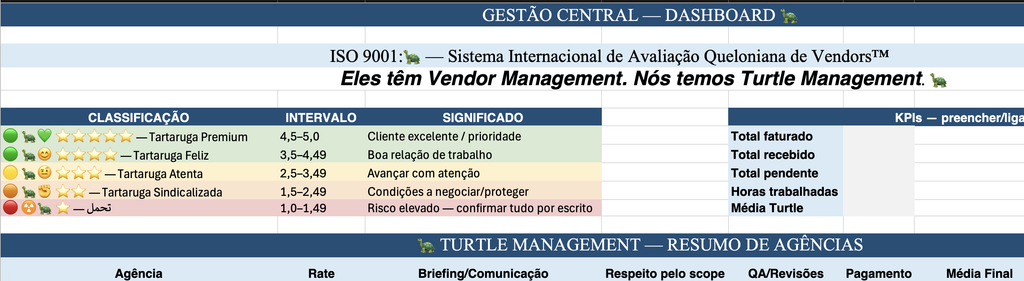
Like many things I do, it started as a silly joke. Unlike most silly jokes, however, this one somehow acquired ratings, scoring ranges, KPIs, colour coding, stars and what my spreadsheet now rather grandly calls the International Turtle Vendor Assessment System™.
The turtles themselves came first. I started using turtle hashtags for situations that kept cropping up at work, including #SuspiciousTurtle, who makes an appearance whenever a translation looks perfectly reasonable but still gives me that irritating feeling that something isn’t quite right. I may not immediately know what the problem is, or even have a particularly convincing reason to suspect one, but I know I’m not clicking Deliver until I’ve checked.
Rather inconveniently, Suspicious Turtle is often right. 🙄🤣🙄🤣
Another turtle emerged from my ongoing battles with tags, placeholders and the various other creatures that inhabit the less glamorous corners of localisation: #TartarugaVelhaAindaAprendeLínguas. I can spend half an hour trying to understand why something works the way it does, fail to understand it the first time, fail again several times afterwards, and still keep digging because I need the why.
Memorising where a tag belongs will solve one string. Understanding what that tag is actually doing can solve the next fifty.
The same applies far beyond tags. Terminology, QA, tools, linguistic decisions, workflows: giving me an answer solves today’s problem, but helping me understand the logic behind it means I may not need the answer tomorrow. It can make me slower at the beginning, certainly, but I’d rather spend twenty minutes understanding something properly once than spend five minutes having exactly the same doubt over and over again.
#AssertiveTurtle took longer to develop, because she required me to unlearn something considerably more difficult: the assumption that having work is always better than not having that particular work.
Some rather unpleasant arithmetic eventually helped.
Being able to do a project doesn’t automatically make it worth accepting. If it requires specialist knowledge, research, sustained concentration, linguistic judgement, responsibility and several hours of my working day, calling it a quick task in an email doesn’t magically make those hours disappear. They still have value, and filling them with poorly paid work doesn’t merely mean earning less on that particular project; it also means those hours are no longer available for something better.
Gradually, saying no stopped feeling quite so much like losing work. Sometimes it simply means refusing to let bad work take up the space where good work could have been.
By then, the turtle population had expanded considerably. There was the cautious turtle, the prepared turtle, the turtle who knows when it is time to fetch the popcorn and, naturally, one of the finest achievements of a quality management system certified by absolutely nobody: #TurtleIsAGoodPersonButNotStupid.
At this point, they were still just hashtags.
Then I opened Excel and things escalated.
My central business management workbook now contains the ISO 9001:🐢 — International Turtle Vendor Assessment System™, complete with classifications ranging from Premium Turtle and Happy Turtle to increasingly cautious and unionised varieties, eventually reaching the red zone where the basic operating principle is: high risk, get everything in writing.
There are stars, colours, KPIs and a Turtle Average.
They have Vendor Management. We have Turtle Management.
Beneath the joke, though, there is a serious reason why I decided to keep it.
Freelancers are evaluated constantly. Agencies and clients track quality, deadlines, productivity, reliability and performance, and entire Vendor Management departments exist to decide whether we are people they want to continue working with.
Yet freelancers don’t always assess clients with anything approaching the same level of structure.
Instead, we rely remarkably often on vague recollections: I think they usually paid on time. Wasn’t this the agency I had that problem with? Didn’t we already negotiate this rate? I remember that client being a lot of work, but what exactly happened?
My memory is not a database, so I decided to build one.
This isn’t about deciding whether I simply like a client. I want to know what actually happened: how much work they sent me, what I billed, what I was paid, how much time I invested, whether payment arrived when promised, whether the project matched the conditions originally presented, whether communication worked, whether problems occurred and, perhaps most importantly, what happened when they did.
A client can offer an excellent rate and still be an operational nightmare. Another may not pay the highest rate in the market but provide consistent work, clear communication, reliable payments and a professional relationship that simply works. And sometimes several indicators quietly begin pointing in the same direction, at which point #PreparedTurtle politely recommends keeping every email.
What I hadn’t expected was that a system designed to track my professional relationships would also end up documenting my own development.
There are things I was asking about a few months ago that I now do automatically, projects I would once have accepted that I would decline today, mistakes I can recognise before I make them and linguistic decisions I can now justify rather than simply saying that one option “sounds better”. There are also plenty of things I still don’t know, because this profession has an impressive ability to introduce you to an entirely new area of knowledge just when you were beginning to feel reasonably competent.
What has changed is that I am much less embarrassed by not knowing.
There was a time when I don’t know this could very quickly become perhaps I’m not good enough at this.
Now it is much simpler: I don’t know? I’ll find out.
I’ll research it, look for documentation, compare sources, ask someone who knows more than I do, test the solution and understand why it works. If I’m wrong, I want to understand that too, because knowing why I got something wrong is far more useful than simply being given the correct answer.
So yes, having an Excel category equivalent to #Unionised Turtle is objectively rather silly, and the International Turtle Vendor Assessment System™ is unlikely to receive formal accreditation any time soon.
But the principle behind it no longer feels silly at all: look for patterns, document what happened, understand why it happened, learn from it and use that information to make the next professional decision slightly better informed than the last one.
It isn’t ISO 9001 nor a certification.
And I strongly suspect it would fail an international audit of chelonian quality management systems.
But it works for me.
The turtle may take her time. But she takes notes. 🐢
ISO 9001:🐢 — Como uma piada se transformou no meu sistema de gestão profissional
Eu acho que, sem querer, criei uma espécie de ISO 9001:🐢 para gerir a minha vida profissional.
Começou como começam muitas coisas comigo: uma piada parva que, a certa altura, deixou de ser assim tão parva e, quando dei por ela, já tinha classificações, intervalos, KPIs, cores, estrelas e um pomposíssimo Sistema Internacional de Avaliação Queloniana de Vendors™ dentro do meu Excel de gestão.
A primeira tartaruga apareceu muito antes disso, quando comecei a usar hashtags para brincar com situações que se repetiam no trabalho. Havia a #TartarugaDesconfiada, que aparecia quando uma tradução até parecia certa, mas havia qualquer coisa ali que me fazia comichão no cérebro. Não sabia necessariamente explicar o quê, nem tinha sempre um argumento concreto para desconfiar; só sabia que não conseguia carregar em «Entregar» sem ir confirmar. E, muitas vezes, havia mesmo qualquer coisa, o que é simultaneamente muito satisfatório e ligeiramente irritante, porque significa que agora já não consigo ignorar a tartaruga quando ela levanta a sobrancelha.
Depois apareceu a #TartarugaEstudiosaNuncaDesiste, normalmente quando estou há meia hora a olhar para tags, placeholders ou outra criatura saída diretamente do inferno da localização e continuo sem perceber por que razão aquilo funciona daquela maneira. Posso não perceber à primeira, nem à quinta, e posso chegar à fase em que estou literalmente a olhar para o ecrã a perguntar «MAS PORQUÊ?» pela décima vez, mas preciso de perceber o porquê, porque decorar onde se põe uma tag resolve uma string; perceber o que aquela tag está ali a fazer resolve as próximas cinquenta.
E isto não vale só para tags. Vale para terminologia, ferramentas, QA, decisões linguísticas, processos de trabalho e praticamente tudo aquilo em que tropeço profissionalmente. Dar-me a resposta resolve o problema de hoje; explicar-me a lógica permite-me não precisar da resposta amanhã. Dá mais trabalho? Muitas vezes. Demoro mais inicialmente? Sem dúvida. Mas prefiro perder vinte minutos a perceber uma coisa uma vez do que perder cinco minutos com a mesma dúvida em cada um dos próximos vinte projetos.
Entretanto chegou a #TartarugaAssertiva. Essa demorou bastante mais porque implicava desaprender uma coisa muito mais complicada do que qualquer placeholder: a ideia de que ter trabalho é sempre melhor do que não ter aquele trabalho.
Foi preciso fazer algumas contas bastante desagradáveis para perceber que aceitar todos os projetos que aparecem não é o mesmo que construir uma carreira. Se um trabalho exige concentração, conhecimento especializado, pesquisa, responsabilidade linguística e várias horas do meu dia, não interessa muito que alguém lhe tenha chamado quick task num e-mail: essas horas continuam a ser horas da minha vida profissional e têm um valor. E, se as ocupar com um projeto que paga muito abaixo do que considero aceitável, não estou apenas a ganhar pouco nesse projeto; estou também a ocupar o tempo em que poderia entrar outro.
Por isso, dizer «não» a uma proposta que não compensa deixou, aos poucos, de me parecer perder trabalho. Às vezes é simplesmente impedir que um mau trabalho ocupe o lugar onde poderia entrar um bom. Outras vezes é proteger o meu tempo, a minha concentração e a qualidade que consigo entregar aos clientes com quem quero realmente trabalhar.
E entretanto a população de tartarugas começou a crescer.
Apareceu a #TartarugaComPulgaAtrásDaOrelha, a #TartarugaPrevenida, a #TartarugaVaiBuscarPipocas e, evidentemente, uma das grandes conquistas deste sistema de gestão da qualidade altamente certificado por absolutamente ninguém: #TartarugaÉBoaMasNãoEstúpida.
Até aqui, ainda podíamos fingir que eram só hashtags.
Depois abri o Excel – e aí a montanha de trabalho administrativo que se deparou pela minha frente foi hercúlea e gigantesca. E entrei em pânico.
O meu ficheiro de gestão central passou a incluir aquilo a que, com toda a solenidade que o assunto evidentemente merece, chamei ISO 9001:🐢 — Sistema Internacional de Avaliação Queloniana de Vendors™.
Há Tartaruga Premium, para clientes excelentes e prioritários; Tartaruga Feliz, quando existe uma boa relação de trabalho; Tartaruga Atenta, quando podemos avançar, mas convém manter os olhos abertos; #Tartaruga Sindicalizada, quando as condições precisam de ser negociadas ou protegidas; e finalmente chegamos ao território vermelho do تحمل, onde a regra é muito simples: risco elevado, confirmar tudo por escrito.
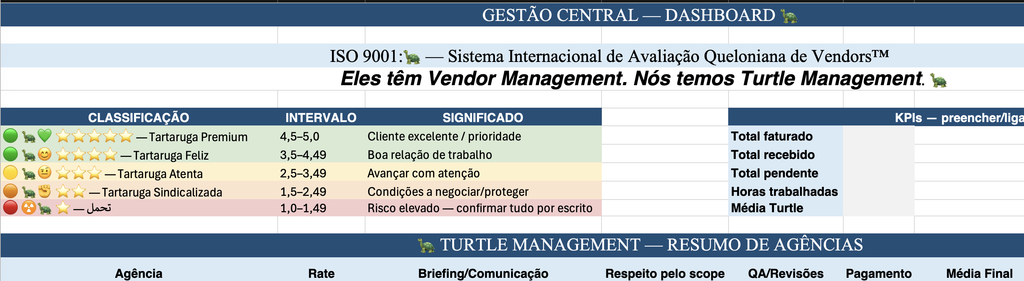
Eles têm Vendor Management. Nós temos Turtle Management.
E é precisamente aqui que a brincadeira começa a tocar numa questão que, para mim, é bastante séria: os freelancers são permanentemente avaliados pelas empresas, mas nós nem sempre avaliamos as empresas com o mesmo rigor.
Existem avaliações de qualidade, métricas de produtividade, prazos, testes, scores, auditorias, revisões e vendor managers a acompanhar o nosso desempenho. Nós, do outro lado, muitas vezes continuamos a gerir relações profissionais com base numa memória bastante menos científica: «acho que estes pagavam a horas», «não foi com esta agência que tive aquele problema?», «tenho ideia de que já tínhamos negociado esta tarifa», «estes davam muito trabalho, mas já não me lembro exatamente porquê».
A minha memória não é uma base de dados. Portanto, agora tenho uma.
E não se trata simplesmente de decidir se «gosto» ou «não gosto» de um cliente. Quero conseguir olhar para aquilo que aconteceu de facto: quanto trabalho me deu, quanto faturei, quanto recebi, quantas horas investi, se pagou dentro do prazo, se as condições inicialmente apresentadas corresponderam ao trabalho real, se a comunicação foi clara, se houve problemas e, sobretudo, como esses problemas foram resolvidos.
Porque uma agência pode pagar muito bem e ser um pesadelo operacional. Outra pode não oferecer a tarifa mais alta do mercado, mas proporcionar trabalho consistente, comunicação clara, pagamentos certos e uma relação profissional que funciona. E há ainda aquelas situações em que todos os indicadores começam discretamente a apontar para a mesma conclusão e a #TartarugaPrevenida recomenda, educadamente, que guardemos todos os e-mails.
O que eu não estava à espera era de perceber que, ao criar este sistema para avaliar relações profissionais, estava também a construir um registo bastante fiel da minha própria evolução.
Há uns meses perguntava coisas que hoje já faço automaticamente. Há trabalhos que aceitava e hoje recusaria. Há erros que já consigo reconhecer antes de os cometer. Há decisões linguísticas que hoje consigo justificar em vez de me limitar a dizer que uma solução «soa melhor». E há muitas coisas que continuo sem saber, porque trabalhar nesta área significa também descobrir regularmente uma nova maneira de perceber que existe um universo inteiro sobre o qual ainda não sabemos absolutamente nada.
Só que agora tenho muito menos vergonha de dizer que não sei.
Talvez essa seja, aliás, uma das maiores diferenças.
Antes, não saber alguma coisa fazia-me pensar que talvez não fosse suficientemente boa. Hoje penso: não sei? Vou estudar até perceber.
Vou pesquisar, procurar documentação, comparar fontes, perguntar a quem sabe mais do que eu, testar, perceber por que determinada solução funciona e, se estiver errada, perceber também onde errei para não voltar exatamente ao mesmo ponto na próxima vez.
É por isso que, por mais cómico que seja ter uma categoria chamada Tartaruga Sindicalizada, o princípio que acabou por nascer desta brincadeira já não me parece nada ridículo: observar padrões, registar o que aconteceu, perceber por que aconteceu, aprender com isso e usar essa informação para tomar a decisão seguinte um bocadinho melhor informada do que a anterior.
Não é ISO 9001.
Não é uma certificação.
E suspeito que não passaria numa auditoria internacional de sistemas quelonianos de gestão da qualidade.
Mas funciona para mim.
A tartaruga pode demorar. Mas leva apontamentos. 🐢




0 Comments